

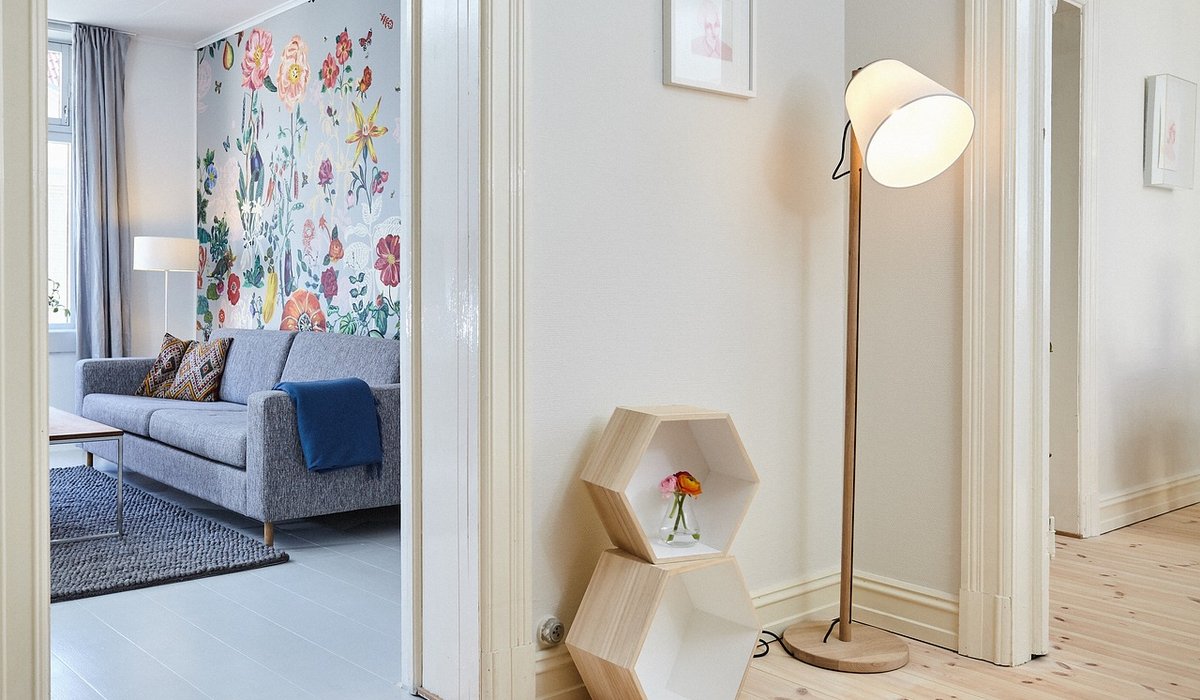
Start With the Corner You Already Have
A proper reading corner does not need a spare room. In a small cottage, terrace or flat it needs roughly a square metre of floor, a chair, somewhere to put a mug, and light you can control. The trick is to look at the spots already doing nothing: the alcove beside a chimney breast, the strip of wall between a door and a window, the dead end of a hallway, or the space under the stairs currently occupied by a hoover and three carrier bags.
Measure before you commit. A generous corner is about a metre wide and a metre deep. A slim chair, a wall-mounted shelf and a standing lamp can be squeezed into 80cm if you are tidy about it. Then apply the seasonal test. From October onwards, daylight fades by mid-afternoon, so a corner that feels charming in June can feel gloomy and uninviting in November. If you would happily sit there at four o'clock in January with a book, it is the right spot. If not, keep looking.
Choose a Chair That Earns Its Keep
Comfort is measurable, and the measurements matter more than the look of the thing.
- Seat height. Sit with your feet flat on the floor and measure from the floor to the crease behind your knee. That figure, usually somewhere between 42cm and 48cm, is the seat height you want. Too low and your knees ride up; too high and your feet dangle.
- Arm height. Your forearms should rest on the arms with your elbows at roughly 90 degrees. Arms that are too high push your shoulders up, and after twenty minutes you will feel it in your neck.
- Back height. In older houses, a high back or a wing chair is worth the extra bulk. It blocks the chill that creeps along the floor and gives you somewhere to lean your head.
- Fabric. Wool and wool blends feel warm the moment you sit down and hold their shape. Leather, lovely as it looks, is a cold surface in an unheated room.
Compact shapes work best in tight spaces: tub chairs, slipper chairs and small wing chairs. If you buy second-hand, check the frame does not rock and that the chair will fit through your doors before you carry it home.
Position It Away From Draughts and Close to Daylight
Older British homes leak cold air in predictable places: sash windows, front doors, cat flaps and unused chimney flues, which quietly pull air down the stack. Sit at least 30cm to 40cm clear of a single-glazed window in winter, or the glass will chill your shoulder even with the heating on.
Resist the temptation to park the chair directly in front of a radiator. You end up with a hot head, cold feet and a blocked heat source. Instead, sit to the side of the radiator, angled slightly towards it, so the room warms around you rather than at you. A simple draught excluder at the door and a lined curtain drawn at dusk will do more for comfort than turning the thermostat up another degree.
For daylight, aim to have the window at your side or over your shoulder. Facing a window directly gives you glare; sitting with your back to it throws your own shadow across the page. Angling the chair at roughly 45 degrees to the wall usually solves both problems and makes a small corner feel deliberate rather than crammed.
The Side Table and the Lamp
A side table should sit level with, or just below, the chair arm, which usually means a top height of about 55cm to 65cm and a diameter of 40cm to 45cm. That is enough for a mug, a book, your glasses and nothing else. In genuinely tight spots, a wall shelf 25cm to 30cm deep, fixed about 70cm above the floor, does the same job without taking up any floor space at all.
Lighting is where most reading corners fail. A single overhead bulb flattens the room and puts glare on the page. Use a table lamp instead, with a warm white bulb of around 2700K and 400 to 600 lumens. Set the bottom of the shade just below eye level when you are seated, so you cannot see the bulb itself, and place the lamp slightly behind and to one side of your shoulder. Try both sides and keep the one that casts fewer shadows over the page.
If you read in the evening, add a second, weaker light somewhere behind you — a small lamp on a shelf, for instance. Lowering the contrast between the page and the room behind it makes long reading far easier on the eyes.
Layer the Warmth and Texture
Warmth in a reading corner is about layers rather than one big gesture.
- Underfoot. A wool rug, even a small one at 60cm by 90cm, defines the corner and insulates cold boards, stone or tile.
- Over you. A wool throw kept in a basket beside the chair. Rotate it seasonally: lambswool from October, lighter cotton from May.
- Behind you. A firm cushion in the small of your back turns an adequate chair into one you can sit in for an hour.
- Under you. A sheepskin or a folded blanket adds warmth and softens a hard seat.
- In front of you. A small footstool keeps your feet off a cold floor and doubles as storage for out-of-season throws.
Keeping the Corner Restful Through the Seasons
Small spaces turn messy quickly, and clutter undoes the calm faster than any colour scheme. Give the corner one basket for throws and one shelf for the books you are actually reading, and keep the floor clear. If you can, angle the chair across the corner rather than pushing it flat against the wall; you use the dead space behind it and gain a few precious centimetres at the front.
Then test it properly. Sit down for half an hour with a book and a cup of tea and see what annoys you. Too much glare, a table that is too low, a draught at ankle height — all of these are easy to fix once you have noticed them. Adjust, and the corner will carry you through the dark afternoons right into spring.


Coding is used in almost all aspects of life and work now, be it directly or indirectly. It’s not just for companies in the tech sector. “An increasing number of businesses rely on computer code,
Coding is used in almost all aspects of life and work now, be it directly or indirectly. It’s not just for companies in the tech sector. “An increasing number of businesses rely on computer code,
Coding is used in almost all aspects of life and work now, be it directly or indirectly. It’s not just for companies in the tech sector. “An increasing number of businesses rely on computer code,